
Asbestos Related Diseases Information

Embedded asbestos fibres irritate lung tissue around them, causing a number of diseases. Asbestos related diseases can take many years to develop. Most diseases will not become apparent for at least 10 years  after exposure to asbestos and more commonly 15-20 years. Some diseases, such as mesothelioma may take up to 40 or more years to develop.

Asbestos-Related Disease Statistics

Malignant mesothelioma is the most common of the asbestos-related diseases monitored in Australia.  This is because there is a strong causal association between asbestos exposure and malignant mesothelioma. Since 2012, annually approximately 800 cases of newly diagnosed malignant mesothelioma cases have been reported with the annual number of mesothelioma deaths increasing from 416 in 1997 to 724 in 2019.

Malignant Mesothelioma
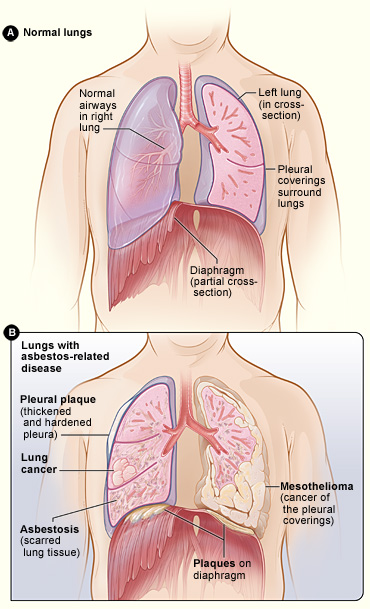
asbestos lungsMalignant mesothelioma (MM) is a cancer arising from the lining (mesothelium) of the thoracic and abdominal cavities. The disease is usually advanced before symptoms appear, making an early diagnosis and effective treatment very difficult. The average survival time after diagnosis is only 10-12 months. A small exposure to asbestos can be enough to trigger the cancer, however a relatively small percentage of people exposed to asbestos fibres will eventually develop mesothelioma. There usually is a lag of 20-50 years after the first asbestos exposure before the disease is diagnosed. Each year in Australia, between 700 and 800 people are diagnosed with the rare and aggressive cancer. 

Malignant mesothelioma almost uniquely caused by asbestos exposure was seldom diagnosed until the 1960’s.  Since 2006 more than 600 Australians were diagnosed with malignant mesothelioma each year and experts have estimated that there were at least another 1,350 Australians with lung cancer caused by asbestos.  A tragic consequence of highly intensive use of asbestos and its products in Australia in the previous century, it is estimated that these figures will continue to rise in the coming decades.  

MM is a disease that develops several years after the first exposure to asbestos fibres.  However, the disease is currently also diagnosed in young adults incidentally exposed to asbestos fibres as children. The fact that approximately 1/3 of older Australian homes built or renovated before the mid 1980’s contain asbestos, reinforces the significance of Australians undertaking adequate preventive measures.  The prognosis of MM patients is poor and almost all will experience severely debilitating symptoms. MM is only partially responding to the current forms of oncologic therapy and currently there is no curative treatment for the disease. It is therefore critical that we make a substantial investment in medical research to find better means of understanding the specific biology of MM in order to try to achieve better clinical outcomes for people affected by the disease.

Pleural Disease

Inflammation of the outer lining of the lung, the pleura (where asbestos fibres are deposited). The pleura stiffens and thickens widely (diffuse thickening) or in patches (plaques), and can fill with fluid.

Asbestosis

This is scarring of the lungs by inhalation of large quantities of asbestos fibres: the lung becomes inflamed and scarred (stiff) making breathing progressively difficult. Symptoms include tightness in the chest, dry cough, and in the later stages, a bluish tinge to the skin caused by lack of oxygen. Asbestosis is usually seen in former asbestos miners, asbestos manufacturing workers and insulation workers, and usually takes a decade or more to develop.

Lung Cancer

Exposure to asbestos fibres greatly increases a person’s risk of developing lung cancer, particularly if they are also a smoker.

Australian Mesothelioma Registry

In August 2020, The Australian Mesothelioma Registry published their Mesothelioma In Australia 2019 Report  which reported 724 deaths and 659 Australian’s newly diagnosed with mesothelioma.

It noted of the 1015 patients who completed the voluntary asbestos exposure questionnaire between 2010-2019, 12.2% classified asbestos exposure through occupational exposure alone, with 35.9% classifying non-occupational exposure and 51.9% selected both occupational and non-occupational exposure.  It reported that:

  • Undertaking home renovations accounted for the possible exposure of 43% of patients 
  • Living in a house undergoing renovations accounted for the possible exposure of 39% of patients 
  • Living in a house made of fibro built between 1947 and 1987 accounted for the possible exposure of 10% of patients 
  • Living in the same home as someone with a job where they were exposed to asbestos and who came home dusty, accounted for the possible exposure of 14% of patients

National Asbestos Exposure Register (NAER)

The National Asbestos Exposure Register (NAER) was established by the Australian Government to record information for members of the community who may have been exposed to asbestos. If you think you may have been exposed, or for more information visit Asbestos Safety and Eradication Agency


REFERENCES

Australian Mesothelioma Registry Reports
Guidelines for the Diagnosis and Treatment of Malignant Pleural Mesothelioma, Asbestos Diseases Research Institute, July 2013

Olsen NJ, Franklin PJ, Reid A, de Klerk NH, Threlfall TJ, Shilkin K, Musk B, 5-Sept-2011, “Increasing incidence of malignant mesothelioma after exposure to asbestos during home maintenance and renovation”, Medical Journal of Australia, 195 (5): 271-274.

Park EK, Hyland R, Yates D, Thomas PS, Johnson A. Prevalence of self-reported asbestos exposure during home renovation in NSW residents. Respirology Supplement 1, Poster 143. March 2010.

Park EK, Hyland R, Yates D, Thomas PS, Johnson A. Asbestos exposure during home renovation in New South Wales. Medical Journal Australasia, September 2013; 199 (6): 410-413.


Dangers of Asbestos

Asbesto Awareness DEC 248

Asbestos is a naturally occurring mineral made up of microscopic fibres that was first used in product manufacturing in the 1920s. Between the mid-1940s until the mid-1980s asbestos was commonly used in the manufacture of thousands of products including building materials.

Although a complete ban on all asbestos-containing materials came into force on 31 December 2003, Australia’s asbestos legacy will continue to cause asbestos-related diseases if fibres are inhaled when asbestos is not managed safely.

When asbestos is disturbed in its natural form (in rural landscapes) or in asbestos-containing products, fibres can be released and become airborne. If inhaled the fibres can cause asbestos-related diseases that can be life-threatening.  

Why Can Asbestos Dust or Fibres be Dangerous to Your Health?

  • You must observe safety precautions when removing or working with asbestos, otherwise you risk exposing yourself and your family to long-term health risks
  • There is no safe level of exposure to asbestos fibres!
  • If asbestos is disturbed it can release dangerous fine particles of dust containing asbestos fibres
  • Breathing in dust containing asbestos fibres can cause asbestosis, lung cancer and mesothelioma
  • Mesothelioma is a cancer which most often occurs in the lining of the lung. There is no cure
  • It is anticipated that incidences of malignant mesothelioma (an incurable cancer) will continue to increase in Australia as a result of Australia’s wide-spread use of asbestos-containing materials
  • The risk of contracting asbestos related diseases increases with the number of fibres inhaled and the length of time that you inhaled asbestos fibres (number of years exposed)
  • The risk of lung cancer from inhaling asbestos fibres is greatly increased if you smoke
  • Symptoms of asbestos dust related diseases do not usually appear until about 20 to 30 years after the first exposure to asbestos
  • The average time between exposure and developing mesothelioma is about 45 years

Contacts

FOR REGULATIONS PLEASE CONTACT

National: Asbestos Safety & Eradication Agency

For details about the regulations in your state visit:


ASBESTOS AWARENESS WEBSITE, MEDIA & CAMPAIGN ENQUIRIES PLEASE CONTACT:

Insight Communications
P: +61 2 9518 4744 
M: PO Box 944, Strawberry Hills, NSW, 2012
E: For email enquiries please complete the below form.

To register for Asbestos Awareness Month click here

Note: Asbestos Awareness is not an asbestos removalist or assessment company. We cannot provide specific advice regarding whether your property contains asbestos.

Fill out my online form.


Useful Links

PRACTICAL GUIDES

IDENTIFYING ASBESTOS

The most accurate way to find out if your fibro building product contains asbestos is to have it tested at a NATA laboratory approved for asbestos identification. You can’t tell by looking at it. If in doubt, assume asbestos is present and take the necessary precautions.

Any inquiries for analysis of suspected asbestos should be directed to NATA – The National Association of Testing Authorities. For a NATA Lab List call 1800 621 666 or refer to their website at www.nata.com.au. When searching for an asbestos testing facility use a capital A in Asbestos.

MR FLUFFY & LOOSE FILL ASBESTOS

For information on loose-fill asbestos ceiling insulation material installed by Mr Fluffy during the 1960s and 1970s in the ACT visit asbestostaskforce.act.gov.au or in NSW please contact Service NSW on 13 77 88 or visit NSW Fair Trading Loose Fill Asbestos Task Force.

ASBESTOS IMPORTS

Asbestos is still widely used in some countries. Despite being a prohibited import in Australia, goods containing asbestos are still being located at the Australian border. For more information visit

ASBESTOS HEALTH & ENVIRONMENT RELATED

STATE & TERRITORY GOVERNMENT INFORMATION & LEGISLATION

Every state and local government has their own legislation and policy in relation to asbestos in the home. Be sure to familiarise yourself with the regulations that effect you.

RESEARCH & SUPPORT GROUPS

LICENCED ASBESTOS REMOVALISTS

WHO TO CONTACT?

Safe Management of Asbestos in Your Home:

  • General asbestos safety issues – Local Council
  • Derelict properties – Local Council

FURTHER INFORMATION

Partners


AMBASSADORS

Cherie Barber

Cherie Barber is well known as Australia’s Renovation Queen™ and is Australia’s foremost expert on renovating.  Cherie is widely respected for her expertise, knowledge and skills in property renovations. With her own unique, down-to-earth natural style, Cherie has featured extensively in the media across all television networks, radio programs, print and online media throughout Australia and internationally.   With her renovating for profit career spanning more than 30 years, Cherie is a highly sought-after public speaker, author and award-winning businesswoman.

Cherie lost her grandfather to asbestos-related disease and is passionate about raising community awareness about the dangers of asbestos when renovating. Cherie has been a dedicated Ambassador for the National Asbestos Awareness campaign to educate homeowners and DIYers on how to renovate homes with asbestos safely since 2013.

“Australians have a love affair with renovating. But many do it in a gunho approach, demolishing walls and the like, in Rambo renovator style, oblivious to the fact that asbestos could be present. I’ve seen it first hand – inexperienced renovators and homeowners unknowingly exposing themselves and their children to asbestos fibres.  And our Aussie attitude of “she’ll be right”, won’t be right, when it comes to asbestos. I personally lost my grandfather to asbestos poisoning and I can tell you, it’s a horrible way to go. It’s my role as an ambassador to help spread the word, that through proper handling and awareness, no Australian in the future, needs to fall victim to this disease. We can put a stop to it. It’s an absolute honour to be involved in such an important cause”.

Scott Cam

AAW12 Scott Cam & Betty 530Scott Cam another of Australia’s most loved television personalities and host of The Block said, “You can’t muck about with asbestos. It’s dangerous stuff. And because most people can’t tell if a material is made of asbestos just by looking at it, before starting a DIY job or a renovation, we want them to visit asbestosawareness.com.au so they have a better understanding of how to go about things to protect themselves and their families.”

Barry Du Bois

Barry Du Bois is an Interior Designer and Master Builder with over 30 years experience. As one of Australia’s best-loved TV personalities, Barry possesses the unique ability to communicate his professional knowledge on design, architecture, renovations and DIY to homeowners who are outside the building industry and features across the resources developed for Tradies.

“The Asbestos Awareness Checklists for Tradies will help save lives.  The easy to follow step-by-step instructions across a broad range of trades gives Tradies the know-how they need to locate possible asbestos-containing materials in any home built or renovated before 1990 so they know what to look for and can manage it safely”

His skill set encompasses everything in the home, from the kitchen bench to the garage, and he has a passion for educating and empowering people to transform their living spaces into something truly special.

Before appearing on TV, Barry had a hugely successful building career. Starting out as an apprentice carpenter, he soon progressed to owning and running his own building company before graduating onto renovating multi-million dollar waterfront homes.

Scott McGregor

124-AAW-Launch-2012Scott McGregor popular for his 30 years in the business and his roles in Better Homes and Gardens and as host of the hugely popular Room For Improvement said, “Many years of renovations on houses great and small has made me very aware of how toxic they can be and asbestos is on top of the list!”

“Too many Australian’s are suffering and dying young through the simple act of handling asbestos around the home. It’s time to get smart with DIY so when it comes to asbestos it’s a definite case of D-DIY, that is, Don’t do it yourself”


About


In 2011, Australia’s first comprehensive asbestos awareness public education campaign and the asbestosawareness.com.au website was launched in NSW with Asbestos Awareness Week which was funded by SafeWork NSW and James Hardie Industries as part of a compensation agreement between James Hardie and the NSW Government.

The 2011 campaign targeted NSW homeowners and renovators where legacy asbestos-containing materials might be found. It’s focus aimed to drive traffic to the asbestosawareness.com.au website. Content was researched, developed and managed by  Insight Communications in consultation with stakeholders, health, work and safety representatives, not-for-profits, medical research organisations, industry experts, and relevant authorities from state and federal governments.

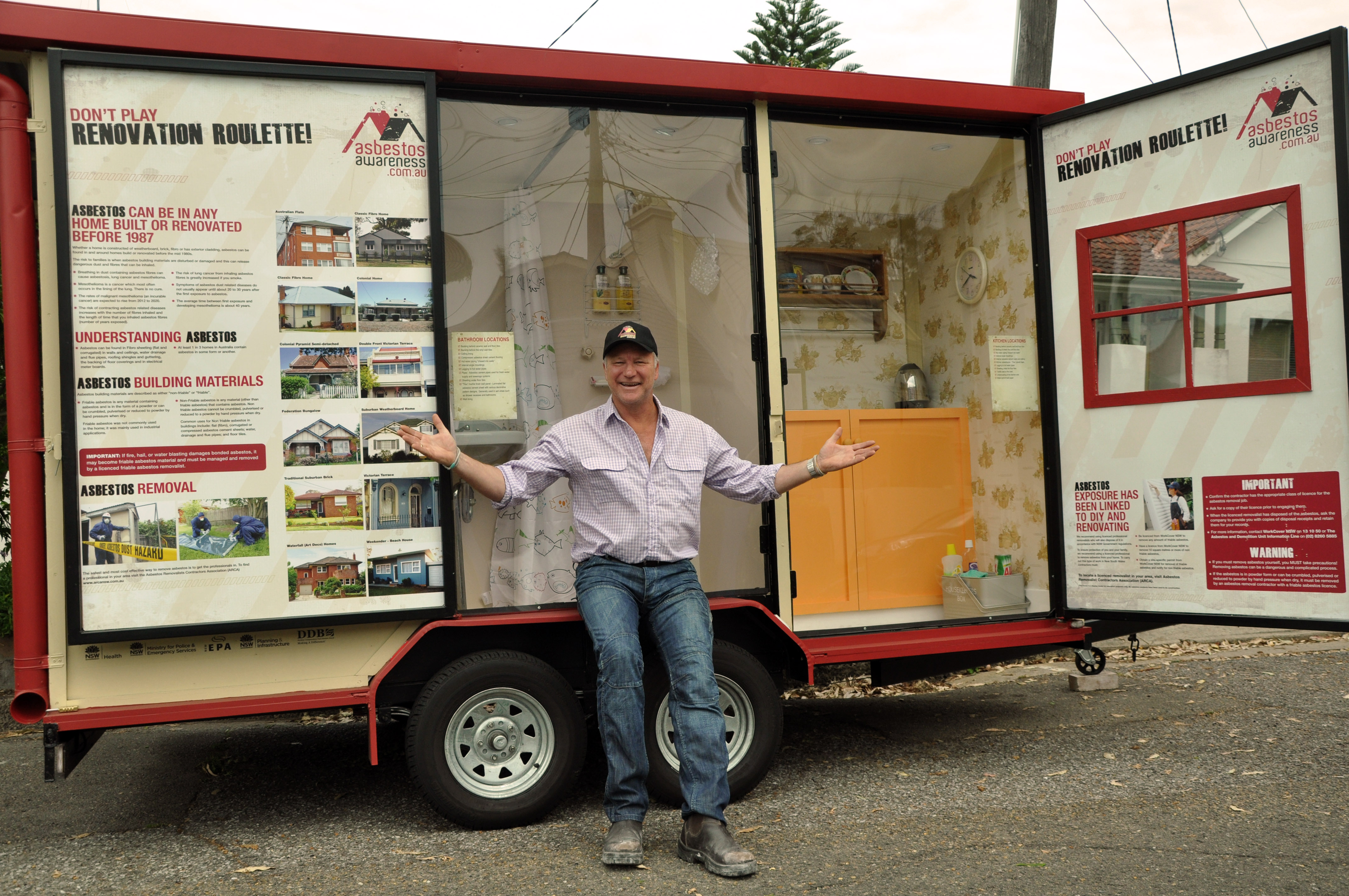
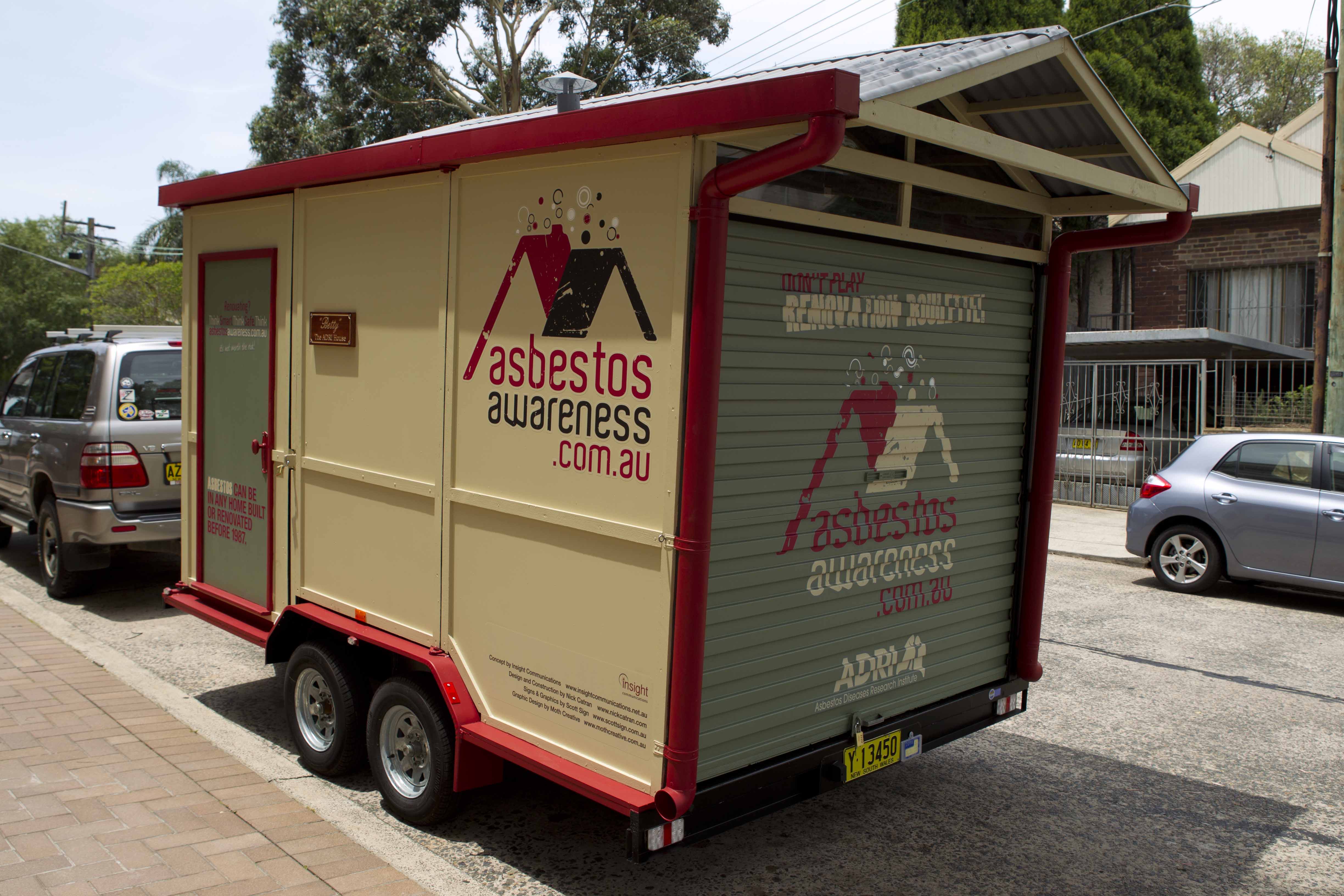
In 2012, Insight developed and launched Australia’s only experiential asbestos education tool, Betty the Asbestos Awareness House. A purpose-built mobile model home, Betty effectively demonstrates where asbestos may be lurking in properties built or renovated before 1990 and directs Australians to authoritative, practical guidance at asbestosawareness.com.au. Since launching Betty has travelled more than 67,000 kilometres across every state and territory except WA and featured at hundreds of council, community, trade and industry events.

Recognising that asbestos poses a national health risk, in 2013, the campaign was rolled out Australia-wide as the National Asbestos Awareness Month Campaign successfully taking awareness of asbestos to all corners of Australia over a four-week period.

From 2013 until 2018, the campaign continued nationally expanding its suite of essential world-first education resources to include tradespersons, commercial property owners and managers, and those living in rural regions where naturally occurring asbestos (NOA) occurs.

The national campaign, the asbestosawareness.com.au website and Betty have received international recognition from medical researchers, academics, asbestos support organisations and industry leaders for sustained contributions to community asbestos awareness, risk management and disease prevention.

In 2018, following changes to program arrangements, including the transfer of oversight from SafeWork NSW to the NSW EPA and the conclusion of James Hardie’s legal obligation to support public asbestos education, the Asbestos Education Committee was disbanded and funding for the Asbestos Awareness campaign and asbestosawareness.com.au came to an end.

Although government funding had ceased, with over 4,000 Australians dying annually (three times the national road toll) and asbestos-related disease mortality projected to continue increasing due to disturbance of legacy asbestos-containing materials during renovation, maintenance and demolition; sustained national awareness and public education remain the only proven prevention strategies to reduce asbestos exposure and save lives.

To ensure these vital public health initiatives could continue, Insight Communications felt compelled to continue the campaign and the website which was created and supported by i-nex.

In 2020, Advocacy Australia was established as a registered charity with the Australian Charities and Not-for-profits Commission (ACNC) and Deductible Gift Recipient (DGR) status. In 2021, it established a new Asbestos Education Committee to continue collaboration with industry and government experts, alongside those affected by asbestos-related diseases, to support the ongoing delivery of the campaign and the development of free preventative education resources.

Since the cessation of government funding, Advocacy Australia and its Asbestos Education Committee have continued to deliver this internationally recognised, multi-award-winning public health initiative with extremely limited resources.

Despite its demonstrated effectiveness and national reach, the sustainability of the campaign and its core educational infrastructure is now at risk due to a lack of appropriate funding.


Asbestos Products Database

The Asbestos Products Database is Australia’s first comprehensive online database to assist homeowners, renovators, tradespeople and some industries to identify asbestos-containing materials so they can be managed safely. The database provides  multiple search options for products commonly used in residential and commercial properties, in agriculture, automotive, industrial, plant and marine products and features over 60 different product types and more than 550 product photographs with descriptions and locations where these products might be found in homes built or renovated prior to 1990. 

Full Size
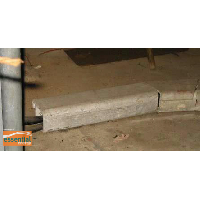
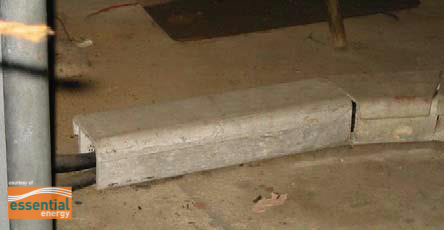
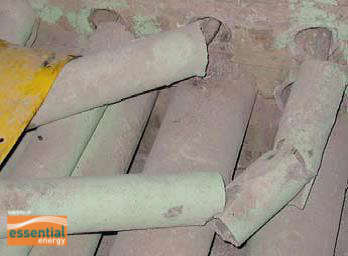
NameCable troughing
CaptionCable troughing
LocationIndustrial
SourceEssential Energy
Image Id242
Full Size
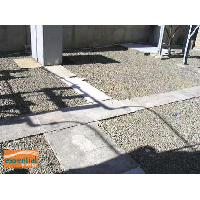
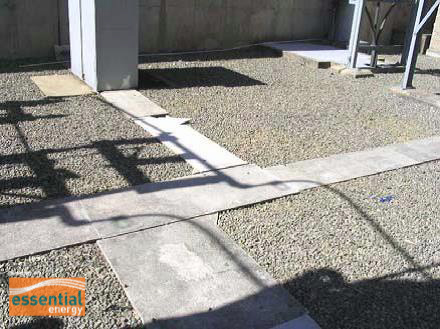
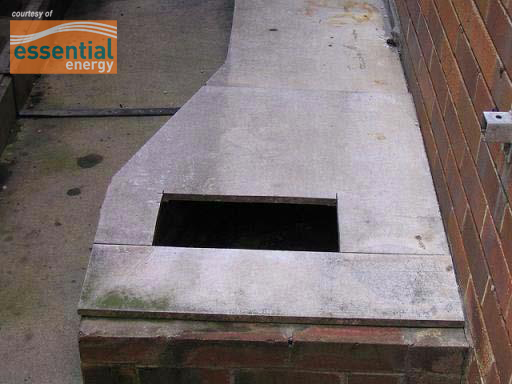
NameTrench covers
CaptionTrench covers
LocationIndustrial
SourceEssential Energy
Image Id243
Full Size
NameAsbestos conduit
CaptionAsbestos cement conduits have been used to install cables and water/drainage services in substations. Fibre cement conduits in the floor adjacent to switchgear and transformers are typically a non-friable asbestos product.
LocationPlant
SourceEssential Energy
Image Id244

Asbestos Cement Conduits

Product description

Hard, brittle material, usually grey in colour with low asbestos content (up to 30 per cent). Asbestos Cement conduits were mainly used to convey HV and LV cables into and out of substations, buried under road crossings, containing cables inside or being empty, used as spares alongside roads or buried in the footpath.Extensively used in pit and duct system in Sydney CBD. Sometimes concreted in substation slabs. The use of AC conduits was stopped around 1987, from that date FRC (fibre reinforced concrete) has been used.


Asbestos has been identified in the fibre-cement material in HV cable joint covers and cable trench covers. Asbestos has also been identified in the moulded cement material in cable conduits. Asbestos may be present in the troughing used to encase joints, both direct buried and in pits.


Asbestos cement conduits have been used to install cablesand water/drainage services in substations. Fibre cement conduits in the flooradjacent to switchgear and transformers are typically a non-friable asbestos product.

Product type Cement - sheets, moulded product
Sub-Product type
Trading name(s)
Other name(s) FC conduits, conduits, AC ducts, ducts, cable joint covers, cable trench covers
Build element
Product identification

Sometimes it is hard to distinguish asbestos cement conduits from cement conduits, the best way is to always take a sample and test. When broken, asbestos-containing conduits will have visible fibres, whereas non-asbestos material will have a clean homogenous break.


Asbestos has been identified in the fibre-cement material inHV cable joint covers and cable trench covers. Asbestos has also beenidentified in the moulded cement material in cable conduits. Asbestos may bepresent in the troughing used to encase joints, both direct buried and in pits.

Known uses Electricity supply
Asbestos fibre type
Friable or Non-Friable Non-Friable
Known Supplier(s)
Known place of manufacture
Date / period of manufacture Pre 1987
Building construction period 1951-1960,1961-1970,1970-1980,1981-1990
Location Commercial
  • Electrical
Industrial
  • Electrical


More Images

Full Size
NameCable pit covers
CaptionCable pit covers inside substations may contain asbestos.
LocationIndustrial
SourceEssential Energy
Image Id245


Download as PDF

Downloads, Media & Resources

Media Centre
Access the media centre for press releases and comprehensive journalist notes. For print ready images visit the downloads page.

Downloads
Everything to help raise awareness about the dangers of asbestos in and around homes. Downloads include high resolution images of asbestos products, hazard locations and promotional images; awareness collateral like posters and flyers available in 6 languages; online web banners; audio visual presentations and videos and various advertising collateral (press ads, radio ads and community service announcements). There are over 270 files to choose!

Resources for Registered Participants
Password Protected: Organisations and individuals who register to participate in the Asbestos Awareness Campaign are provided with a password to access special resources tailored to help them educate their communities. To access these resources please register.


Gallery & Videos

For a comprehensive range of images with descriptions of asbestos containing materials, visit the Asbestos Products Database.


Betty The Asbestos Education House


AAW12 Scott Cam & Betty 530
Scott Cam meets Betty

Betty The Asbestos Education House

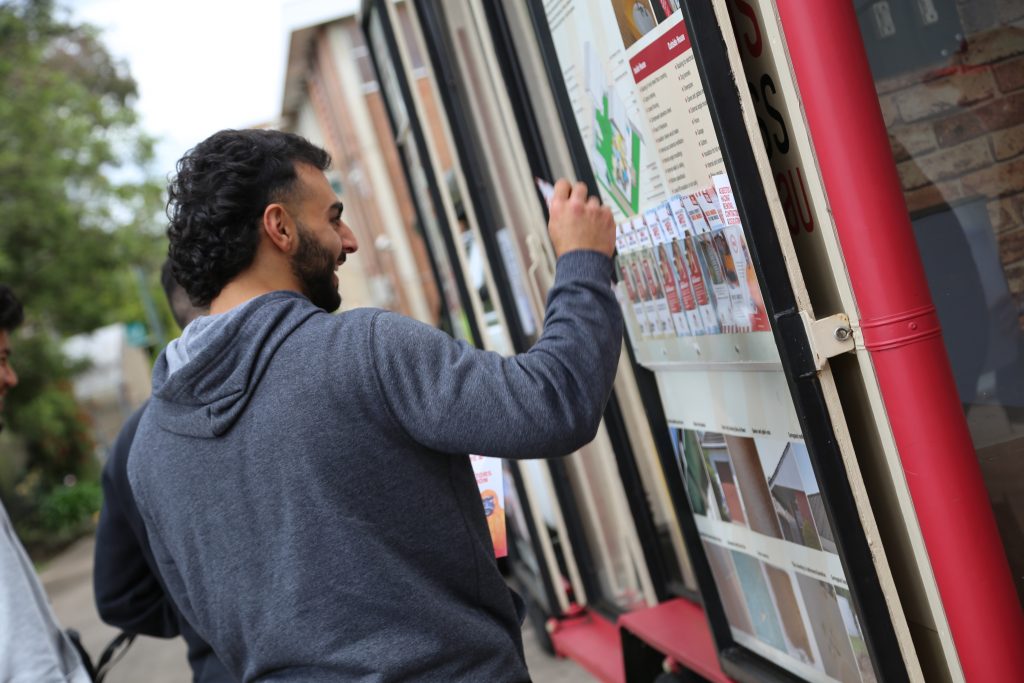
The first and only exhibit of her kind in Australia and the world, Betty – The Asbestos Education House is a community engagement and experiential awareness tool with the mission to save lives through educating Australians about the dangers of asbestos and how to manage it safely.

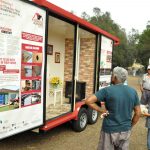
Created by Insight Communications, Betty is a purpose-engineered, mobile model home designed to demonstrate where asbestos might be found in and around any Australian home built or renovated before 1990. Betty’s exterior resembles a typical fibro home but when opened, she has extensive audio and visual information including a bathroom, kitchen, living room, man shed/garage and a doghouse.

Betty features integrated audio-visual capability and independent power supply, enabling exhibitions in metropolitan, regional and remote locations, including field days and outdoor events. Weighing approximately 1.42 tonnes and measuring 5.5 metres in length (including tow bar), 2.4 metres in height and 2.9 metres in width, Betty requires an appropriate four-wheel-drive tow vehicle for safe transport and deployment.

Betty visits Granville Tafe 2022

Betty drives traffic to asbestosawareness.com.au free resources

A key additional purpose of Betty is to direct Australians to asbestosawareness.com.au. Betty is a proven, award-winning experiential education initiative, and when she’s deployed, website traffic increases by around 190%, demonstrating strong behaviour-response and information uptake of our authoritative, practical education resources.

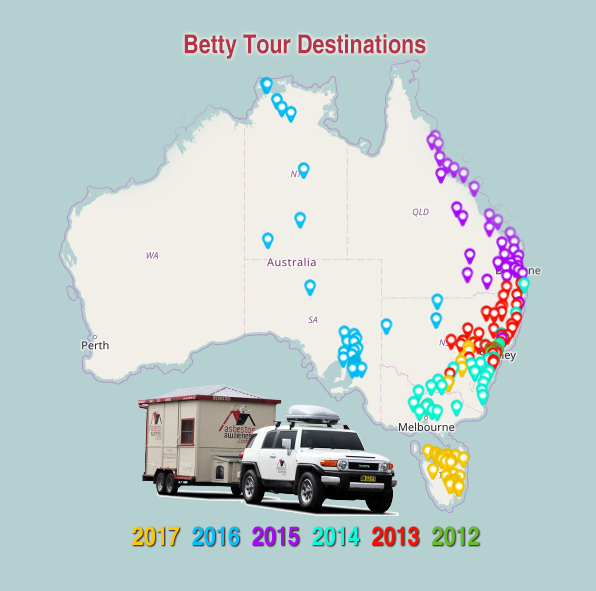
Between 2012 to 2017, Betty travelled more than 65,000 kilometres across every state and territory except Western Australia, appearing at hundreds of council, community, trade and industry events including major field days (AGQUIP), home shows and community shows (Sydney Royal Easter Show twice), retail outlets and over 73 Bunnings Warehouse Stores with tour funding and a tow vehicle provided by SafeWork NSW.

Betty has toured as far West as Uluru, as Far North as Cairns, as far South as Port Arthur (after a trip on the Spirit of Tasmania), and has toured to the back of Bourke, Coober Peedy and beyond.

To date, during Betty’s lifesaving adventures she’s delivered 265 public appearances, supported 213 media calls, and featured in more than 1,050 media pieces including national television, print radio and online, in multiple states and jurisdictions.

Geoff and Karen Wicks

Geoff and Karen Wicks – Betty’s Curators

Betty’s tours are supported by her trained volunteer curators and chauffeurs, Geoff and Karen Wicks who enable Betty to educate the community while tending to her maintenance and upkeep. Geoff, a retired avionics engineer and avid DIYer and Karen, a retired hospitality professional, make a highly skilled team that delivers Betty’s lifesaving asbestos education message.

In recognition of their long-standing service to the community (since 2012), Geoff and Karen have been recognised with two SafeWork NSW special awards and a NSW Volunteer Team of the Year award.

National and International Recognition of Betty and Asbestos Awareness

Betty, asbestosawareness.com.au and our Australia-wide Asbestos Awareness campaigns have received national and international recognition from researchers, academics, asbestos diseases support groups and industry leaders for sustained public health asbestos awareness and prevention education activities.


Funding for Betty is Needed

Despite Betty’s proven effectiveness, since 2018, except for a handful of appearances, Betty has been off the road due to funding cuts. To help save lives, sustainable funding is desperately needed to maintain Betty’s operations, support touring capacity and extend delivery of this vital resource to under-served regions.

Only through funding can we ensure Betty and her dedicated crew can get back on the road to educate the community about asbestos risks and how to manage asbestos safely.

Bunnings Woodville, South Australia 2016

Betty’s Impact Snapshot

Since launching in November 2012 Betty has:

  • Travelled over 67,000 km (as of March 2026)
  • Been seen in person by over 1.5 million Australians
  • Had 265 public appearances
  • Held 213 Media Call events
  • Generated +1050 media pieces across TV, print, radio and online
  • Been displayed at 73 Bunnings Stores in NSW, NT, QLD, SA, TAS, and VIC
  • Attended 13 TAFEs
  • Toured every state and territory except WA. 
  • Partnered with councils across NSW, NT, QLD, SA, TAS, and VIC
  • Visited various community events including:
    • TAFE NSW
    • The Sydney Royal Easter Show in 2013 and 2015
    • The Sydney Home Show
    • AGQUIP
    • Disaster Risk Awareness Festival 2025
    • The Ballina Home Show
    • Coffs Harbour Waste Conference
    • Home and Garden Show Bowral
    • Lithgow Council Annual Safety Day 2014
    • The Living Room
    • Mona Vale Markets
    • NAIDOC Week Events 2013, 2014, 2016, 2017, 2019, 2018
    • Parramatta Council’s Australia Day Celebrations at Parramatta Park
    • Ag Shows: The Royal Agricultural Society’s Camden Show, Parks Show and Condobolin Show
    • Tocal Field Days
    • Festivals: Seven Hills Festival 2025, Wilmot Festival 2024, Georges River Council’s Oatley Village Festival
    • Fairs: Strathfield Spring Fair, Hills Shire Council’s Crestwood Fair

 Follow Betty on Facebook

To partner with Asbestos Awareness and become a sponsor of Betty and the vehicle that tows her, please contact us to request a Partnership Prospectus.

Betty Physical Stats:

  • Weight: 1.42 Tonne
  • Towbar Weight: 100kg
  • Body Length With Draw Bar: 5.5m Long
  • Body Length – Just House: 3.6m Long
  • Width: 2.4m Wide
  • Height: 2.9m Tall
  • Power: 240v – also has her own generator